
China has voiced strong opposition to India's recent decision to standardise names for 28 strategic locations and geographical features in Ladakh.

The Indian Army is one of the very few armies in the world that operates tanks at high altitudes up to 16,000 feet, and in large numbers.
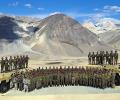
China has said that the disengagement of troops in eastern Ladakh by the Chinese and Indian armies is going on "smoothly" following a recent agreement between the two nations.
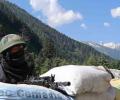
The Army Chief was in Ladakh on a two-day visit from June 23 to take stock of the situation.
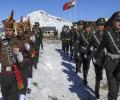
The focus of the deliberations was on finalising modalities for disengagement of troops in eastern Ladakh.

'Eastern Ladakh set the relationship back by about 10 steps. So far, especially since Galwan, we may have taken just 4 steps forward.'
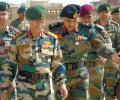
In his initial remarks, Army Chief General M M Naravane briefed the commanders about the overall situation following which detailed discussions on the matter took place, the sources said.

The Indian Army will continue to maintain its aggressive posturing in all disputed areas in eastern Ladakh and will not back off till status quo is maintained, sources said.

The Indian Army's Shatrujeet brigade is conducting an airborne exercise along the northern borders in eastern Ladakh to validate its rapid response capabilities, sources said on Monday.
Her comments come a day after External Affairs Minister S Jaishankar said in Geneva that roughly 75 percent of the "disengagement problems" with China are sorted out but the bigger issue has been the increasing militarisation of the frontier.

The situation that developed in eastern Ladakh last year required acclimatisation of a large number of IAF personnel and stretching of equipment to limits, but the force is "much better prepared" now in case there is a "long haul", Chief of Air Staff Air Chief Marshal V R Chaudhari said on Thursday.

Top commanders of the Indian Army on Monday carried out a comprehensive review of the country's security challenges, including in eastern Ladakh and other sensitive areas along the Line of Actual Control (LAC) with China, on the opening day of a four-day conference, people familiar with the developments said.

In the meeting, Doval conveyed to Wang that peace and tranquillity in border areas and respect for the Line of Actual Control are essential for return of normalcy in bilateral ties, according to the ministry of external affairs.
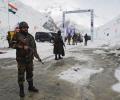
External affairs ministry spokesperson Arindam Bagchi said it is essential that "appropriate agreements between India and China of 1993 and 1996 are scrupulously followed".

India and China on Monday held a fresh round of military talks with a focus on disengagement of troops in the remaining friction points in eastern Ladakh and ease overall tensions in the region.

The sources also said both the Indian and Chinese troops are firmly holding on to their respective positions at the Line of Actual Control.
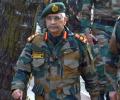
Chief of Army Staff Gen MM Naravane on Friday visited several forward areas in eastern Ladakh and carried out a comprehensive review of India's operational preparedness in the backdrop of its prolonged military standoff with China in the mountainous region.

During the session, General Dwivedi was asked about the overall challenges for the India Army going forward and learning from the border row in eastern Ladakh.
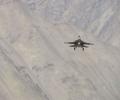
The frequency of day and night operations by frontline fighter jets is a signal that India will continue to put pressure on China until the status quo ante is restored in all the areas in eastern Ladakh including Pangong Tso, Gogra and Hot Springs, government sources said.

On Saturday, Prime Minister Narendra Modi and Chinese President Xi Jinping met on the sidelines of the BRICS Summit in New Delhi.

China Southern Airlines is set to resume its Guangzhou-New Delhi passenger service from September 21, ending a six-year suspension. This move is part of a broader normalisation of India-China relations, following recent high-level diplomatic meetings and previous flight resumptions by other carriers.

Chinese President Xi Jinping's first visit to India in seven years for the BRICS Summit and bilateral talks with Prime Minister Narendra Modi is set to address crucial aspects of India-China relations, including trade, investment, and persistent border tensions.

The enhancement of combat capability by the two armies in the region came even as both the countries continued their efforts to resolve the dispute through talks at military and diplomatic levels.

India recently outflanked China by taking control of strategic height near Pangong lake's southern bank.
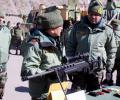
The Chinese aircraft have been regularly flying close to the LAC in the last three to four weeks which is seen as an attempt to probe the Indian defence mechanism in the area.

Amid tensions over build-up by the Chinese across the Line of Actual Control (LAC) in Eastern Ladakh and reluctance to resolve remaining issues between the two countries, Indian Air Force (IAF) chief Air Chief Marshal VR Chaudhari is visiting forward areas in Ladakh to review the operational preparedness of troops deployed there.
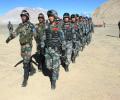
Singh said a meeting between senior Indian and Chinese military leaders has been scheduled for June 6 even as he asserted that India is not going to back off from its position. Asked about the current situation in sensitive areas in eastern Ladakh, he said Chinese have come up to what they claim is their territory while Indians believed it is theirs.

'Therefore, Beijing comes to wrong conclusions.'

The Indian Army captured Thang in Ladakh in the 1971 War. Ghulam Hussain had left home for a routine errand found himself on the other side of an altered border. He could never return and found a new country and a new home.
Prime Minister Narendra Modi, in bilateral talks with Chinese President Xi Jinping, emphasized that both nations must show sensitivity to each other's core issues and be guided by mutual respect, sensitivity, and interest. Modi highlighted the critical importance of peace and tranquillity along the Line of Actual Control for the development of India-China relations, while also addressing concerns regarding Taiwan and Tibet.

Indian Army chief General Manoj Mukund Naravane on Tuesday said that as far as the western front was concerned, there is an increase in the concentration of terrorists in various launch pads and there have been repeated attempts of infiltration across the Line of Control.

The country will not allow any "unilateral action" on its border and will pay any cost to thwart such attempts, he told the Bharatiya Janata Yuva Morcha's state conference.

'My task includes providing strategic operational communication to further-most troops located in the vicinity of Line of Actual Control.'

Lack of infrastructure development in Jammu and Kashmir for decades post Independence was one of the reasons behind the rise of terrorism in the Union territory, Defence Minister Rajnath Singh said on Friday after unveiling 75 new projects including bridges, roads and helipads in border areas.

National Security Adviser Ajit Doval held "constructive" talks with Chinese Foreign Minister Wang Yi in New Delhi, focusing on the normalisation of bilateral ties. The discussions reviewed recent developments and progress towards rebuilding trust after the eastern Ladakh border standoff. Both sides have implemented measures, including disengagement pacts and high-level meetings, to improve relations.

External Affairs Minister S Jaishankar stated that the stability of the Line of Actual Control (LAC) is essential for normalising India-China relations, asserting that border disturbances will have consequences. He connected trade and investment growth to border peace and highlighted significant economic issues, including a severe trade imbalance and lack of market access for India in China. Jaishankar also referenced the 2020 Galwan clashes as a critical turning point, underscoring the profound impact of border tranquillity on the overall bilateral relationship.

China emphasises proper handling of differences and a long-term perspective for bilateral ties ahead of President Xi Jinping's visit to India for the BRICS summit and talks with Prime Minister Narendra Modi. The visit aims to stabilise relations following the 2020 Ladakh standoff and strengthen BRICS cooperation.

Chinese President Xi Jinping's upcoming visit to India for the BRICS summit is a pivotal diplomatic event poised to significantly impact bilateral ties and global cooperation amidst ongoing international instability.

Chinese President Xi Jinping is in New Delhi for the 18th BRICS Summit, where he is scheduled to hold bilateral talks with Prime Minister Narendra Modi. This visit, his first to India in nearly seven years, comes amidst efforts to normalise India-China relations following the 2020 Eastern Ladakh standoff and is expected to have significant implications for bilateral ties and BRICS cooperation.

External Affairs Minister S Jaishankar met his Chinese counterpart Wang Yi in Manila, reiterating that peace and tranquillity in border areas are prerequisites for normal India-China relations. He stressed the importance of mutual respect, interest, and sensitivity, while also raising concerns about market access, trade imbalance, and supply chain uncertainties.
